English
 日本語
日本語 한국어
한국어 français
 Deutsch
 Español
 italiano
 русский
 português
 Türkçe
 العربية


Selecting laminated glass for an architectural project requires careful consideration of safety, structural performance, acoustic requirements, aesthetics, and long-term durability. Unlike standard monolithic glass, laminated glass uses an interlayer system that improves safety and provides additional functional benefits.
Among different laminated glass solutions, PVB laminated glass is widely used in commercial buildings, residential projects, façades, skylights, and security applications because it combines transparency with enhanced protection.
For architects, contractors, and glass purchasers, choosing the correct specification involves more than selecting glass thickness. Factors such as glass composition, PVB interlayer thickness, environmental exposure, loading requirements, and project standards must all be evaluated.
A properly specified laminated glass system can improve building safety, occupant comfort, and overall architectural performance.
PVB laminated glass consists of two or more layers of glass bonded together with a polyvinyl butyral (PVB) interlayer.
During production, the glass layers and PVB film are assembled under controlled temperature and pressure conditions, creating a strong composite structure.
The PVB interlayer provides several important functions:
Holds glass fragments together after breakage
Improves impact resistance
Reduces noise transmission
Blocks ultraviolet radiation
Enhances design flexibility
For projects requiring safety and durability, PVB laminated glass is often selected because it provides reliable performance across different architectural environments.
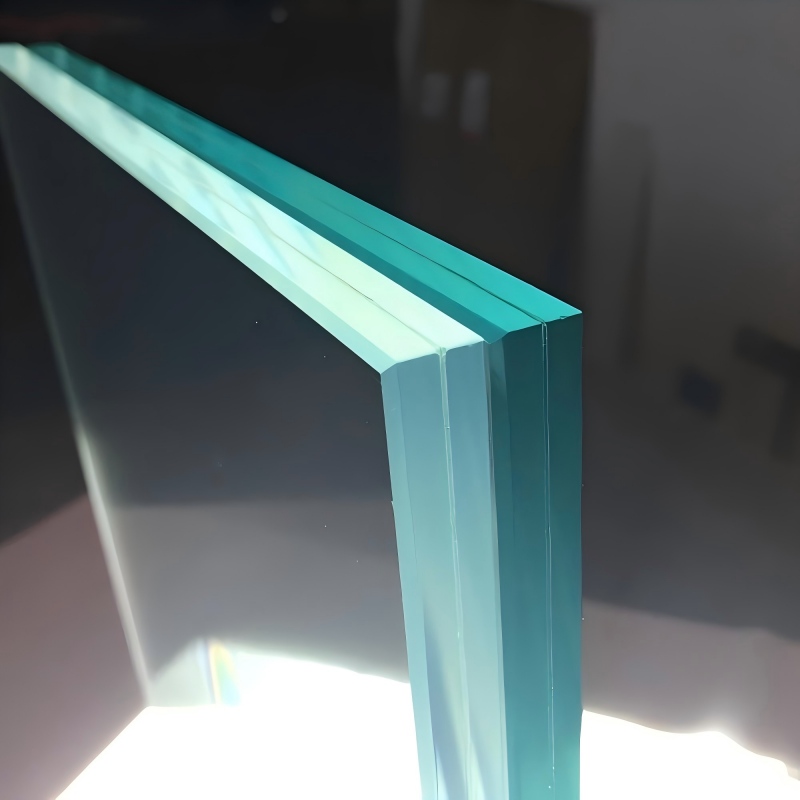
Safety is one of the primary reasons architects specify laminated glass.
When ordinary glass breaks, fragments may separate and fall, creating potential hazards. In laminated glass, the PVB interlayer helps maintain adhesion between glass layers.
After impact:
Glass cracks but remains attached
Fragments are held by the interlayer
The opening remains partially protected
This characteristic makes laminated glass suitable for applications where human safety is critical.
Common applications include:
Curtain walls
Glass entrances
Skylights
Balustrades
Overhead glazing
Public buildings
A complete laminated glass specification should include several technical parameters.
Glass thickness affects:
Mechanical strength
Load resistance
Deflection performance
Structural safety
Common combinations include:
| Configuration | Typical Application |
|---|---|
| 5+0.76+5 mm | Residential glazing |
| 6+1.14+6 mm | Commercial applications |
| 8+1.52+8 mm | Higher safety requirements |
| Customized structures | Large façades and special projects |
The correct thickness depends on:
Building height
Wind pressure
Panel size
Installation method
Local regulations
The PVB interlayer plays an important role in laminated glass performance.
Different thickness levels provide different functional characteristics.
| PVB Thickness | Main Characteristics |
|---|---|
| 0.38 mm | Standard safety applications |
| 0.76 mm | Improved safety and durability |
| 1.14 mm | Higher impact resistance |
| 1.52 mm or above | Security and demanding applications |
A thicker interlayer generally improves:
Impact resistance
Structural performance
Acoustic insulation
However, the appropriate choice depends on project requirements rather than simply selecting the thickest option.
Noise control has become increasingly important in modern buildings, especially in:
Airports
Hotels
Office buildings
Residential developments
Urban environments
The PVB interlayer helps reduce sound transmission by absorbing vibration energy.
Compared with standard glass, laminated glass can provide improved acoustic comfort.
Performance depends on:
Glass thickness
Interlayer type
Air space configuration
Installation quality
For projects requiring enhanced sound insulation, acoustic PVB interlayers may be considered.
One important advantage of PVB laminated glass is ultraviolet protection.
The PVB layer can block a significant amount of UV radiation, helping protect:
Furniture
Flooring
Artwork
Interior materials
This makes laminated glass suitable for buildings where interior preservation is important.
Applications include:
Museums
Luxury residences
Retail spaces
Hotels
Architectural projects may require different laminated glass configurations depending on design goals.
Used when maximum transparency is required.
Applications:
Office façades
Commercial buildings
Residential windows
Provides design flexibility through different colors and appearances.
Applications:
Decorative façades
Interior partitions
Architectural features
Designed for projects requiring improved sound control.
Applications:
Transportation buildings
Urban residential projects
Noise-sensitive environments
Uses thicker glass and interlayer systems for enhanced protection.
Applications:
Banks
Government buildings
High-security facilities
Curtain wall systems require careful consideration because glass panels are exposed to environmental loads.
Important factors include:
Glass thickness and configuration must be calculated according to:
Building height
Location
Wind conditions
For large façades, designers should evaluate:
Visible light transmission
Solar heat gain
Reflectance
Architects may consider:
Glass color
Reflection level
Transparency
Interior appearance
High-quality architectural laminated glass allows designers to combine safety requirements with aesthetic objectives.
Architectural laminated glass specifications commonly reference international standards, including:
| Standard | Purpose |
|---|---|
| EN 14449 | Laminated glass product standard |
| ASTM C1172 | Laminated architectural flat glass specification |
| ANSI Z97.1 | Safety glazing performance requirements |
Compliance requirements depend on project location and building regulations.
Professional suppliers should provide:
Test reports
Certification documents
Product specifications
Before ordering laminated glass, buyers should review several aspects.
Check:
Glass thickness accuracy
PVB bonding quality
Surface defects
Edge quality
Evaluate:
Manufacturing equipment
Quality control procedures
Custom processing ability
Request:
Technical data sheets
Test certificates
Inspection reports
Proper packaging helps prevent:
Edge damage
Moisture exposure
Surface scratches
A reliable supplier should provide complete support from specification selection to delivery.
Lanjing Glass Technology provides professional laminated glass solutions for architectural and industrial applications.
The company supports customers with:
Customized glass configurations
Different PVB interlayer options
Quality inspection
Project-based recommendations
Through advanced manufacturing processes and strict quality management, Lanjing helps architects, contractors, and developers select suitable laminated glass solutions for different building requirements.
Although laminated glass provides excellent safety and performance advantages, incorrect specification choices can reduce its effectiveness.
Architects and buyers should avoid several common mistakes.
One of the most common errors is choosing glass thickness based only on appearance or previous projects.
Actual requirements depend on:
Wind pressure
Glass size
Building height
Support conditions
Installation location
A professional glass supplier should evaluate structural requirements before recommending a configuration.
The PVB interlayer is not simply a bonding material. It directly influences:
Safety performance
Acoustic insulation
UV protection
Structural behavior
Different projects may require:
Standard PVB
Acoustic PVB
Colored PVB
Security-grade PVB
Selecting the correct interlayer is essential for achieving the intended performance.
The lowest-cost laminated glass option may not provide the required durability or certification.
Buyers should compare:
Glass quality
Interlayer performance
Manufacturing capability
Quality documentation
A reliable laminated glass supplier should provide technical support instead of only competing on price.
Laminated glass performance depends not only on the glass itself but also on processing quality.
Important inspection points include:
Edge finishing
Cutting accuracy
Hole drilling quality
Surface condition
Bonding consistency
Poor processing may create installation difficulties or reduce long-term reliability.
PVB laminated glass is widely used across different architectural sectors.
Applications include:
Curtain walls
Entrance façades
Shopping centers
Office buildings
The combination of safety and aesthetics makes laminated glass suitable for high-traffic environments.
Laminated glass is commonly used for:
Windows
Balconies
Skylights
Interior partitions
Benefits include:
Improved safety
Better sound insulation
Enhanced comfort
Applications include:
Airports
Railway stations
Public terminals
These environments often require glazing systems with enhanced safety performance.
Laminated glass is also used in:
Museums
Exhibition centers
Luxury buildings
Structural glass installations
These projects often require customized solutions combining appearance and performance.
Before accepting a shipment, buyers should perform quality checks.
Check for:
Air bubbles
Delamination
Foreign particles
Scratches
Edge defects
Verify:
Glass thickness
Length and width
Shape accuracy
Edge processing
Request:
Product certificates
Test reports
Production records
Quality inspection documents
For international transportation, confirm:
Protective packaging
Moisture prevention
Corner protection
Proper loading methods
A professional supplier should maintain consistent quality control throughout production and shipping.
The primary advantage is improved safety. When broken, the PVB interlayer helps hold glass fragments together, reducing the risk of falling pieces and maintaining partial protection.
Common configurations include:
5+0.76+5 mm
6+1.14+6 mm
8+1.52+8 mm
The correct thickness depends on structural requirements, building design, and safety regulations.
Yes. The PVB interlayer absorbs vibration and can improve acoustic performance compared with standard monolithic glass. Acoustic performance depends on the complete glazing system.
Yes. PVB interlayers can significantly reduce ultraviolet transmission, helping protect interior materials such as furniture, flooring, and artwork.
Tempered glass is heat-treated to increase strength and breaks into smaller fragments, while laminated glass uses an interlayer to hold broken pieces together.
Some projects combine both technologies, such as tempered laminated glass, to achieve higher safety performance.
Buyers should evaluate:
Manufacturing experience
Product certifications
Quality control systems
Customization capability
Technical support
A reliable supplier should provide complete documentation and recommendations based on project requirements.
Specifying PVB laminated glass for architectural projects requires a comprehensive understanding of safety requirements, structural performance, interlayer selection, and long-term durability.
The correct laminated glass configuration depends on many factors, including building location, application type, environmental conditions, and design objectives.
From façade systems and residential buildings to specialized architectural structures, laminated glass provides a combination of safety, comfort, and design flexibility.
Lanjing Glass Technology provides customized laminated glass solutions designed for architectural and industrial applications. With professional processing capabilities, strict quality control, and technical support, Lanjing helps customers select suitable glass configurations based on project requirements.
https://www.astm.org/c1172.html