English
 日本語
日本語 한국어
한국어 français
 Deutsch
 Español
 italiano
 русский
 português
 Türkçe
 العربية




In 2026, perovskite solar cells are transitioning from laboratory record-setting to pilot-scale and mass-production validation — and the manufacturing challenges that emerge at this transition stage are fundamentally different from the challenges of laboratory device optimization. In the laboratory, researchers can optimize every processing step individually, use small substrate areas where uniformity is easier to achieve, and tolerate batch-to-batch variation that would be commercially unacceptable at production scale. In pilot and mass production, the substrate must perform consistently across large areas, through repeated thermal processing cycles, and across thousands of production batches — requirements that make substrate selection a direct determinant of yield, stability, and power conversion efficiency at scale.
FTO glass — fluorine-doped tin oxide coated conductive glass — has emerged as the preferred substrate for high-temperature perovskite solar cell manufacturing because it addresses the most critical substrate performance requirement at production scale: thermal stability. Many perovskite solar cell architectures use TiO₂-based electron transport layers that require annealing at temperatures around or above 450°C — a thermal processing condition that places significant stress on the transparent conductive oxide layer of the substrate. FTO conductive glass maintains its sheet resistance, optical transparency, and surface integrity through these high-temperature processing steps in ways that ITO glass cannot reliably match, making it the practical substrate choice for perovskite manufacturers who need consistent device performance across large-area production.
Lanjing Glass offers FTO conductive glass in multiple resistance grades — including TEK10, TEK15, TEK35, TEK70, and TEK250 — with published performance data covering visible light transmittance, haze, reflectance, and sheet resistance before and after tempering, designed for photovoltaic applications including perovskite solar cells, dye-sensitized solar cells, organic photovoltaic cells, and thin-film solar cells. This guide covers the complete picture for photovoltaic manufacturers and research teams evaluating substrate options for perovskite scale-up: why high-temperature processing creates substrate performance requirements that ITO cannot reliably meet, what FTO glass is and how it functions in perovskite device structures, how FTO's thermal stability protects sheet resistance and power conversion efficiency through annealing, how FTO compares to ITO across the key selection factors for photovoltaic manufacturing, and what procurement and handling practices protect substrate quality through the production process. Secondary keywords relevant to this decision — FTO glass for perovskite solar cells, high-temperature conductive glass, FTO vs ITO for photovoltaics, and FTO glass efficiency — are addressed throughout.
The commercial case for FTO glass in perovskite solar cell manufacturing starts with a clear understanding of why the thermal processing requirements of high-efficiency perovskite device architectures create substrate performance challenges that ITO glass — despite its strong conductivity and high transmittance — cannot reliably address at production scale.
The most widely used high-efficiency perovskite solar cell architectures employ TiO₂-based electron transport layers — either compact TiO₂ blocking layers, mesoporous TiO₂ scaffolds, or both — that require high-temperature annealing to achieve the crystallinity, density, and electronic properties needed for efficient charge extraction. Research literature consistently reports that solution-processed TiO₂ and related metal-oxide electron transport layers commonly require annealing temperatures around or above 450°C — and mesoscopic perovskite solar cell architectures with TiO₂ scaffolds can require processing at similar or higher temperatures.
At these temperatures, the transparent conductive oxide layer of the substrate is subjected to significant thermal stress. The key question for substrate selection is not simply whether the conductive oxide survives the annealing temperature — it is whether the sheet resistance, optical transmittance, and surface uniformity of the conductive oxide remain stable enough after annealing to support consistent device performance across large-area production batches.
In perovskite solar cell manufacturing, the sheet resistance of the transparent conductive substrate directly affects device performance through its contribution to series resistance. If sheet resistance increases significantly after high-temperature annealing, the series resistance of the finished device increases — reducing fill factor, reducing current collection efficiency, and reducing power conversion efficiency. In large-area module production, where current must be collected across a larger substrate area, the impact of sheet resistance increase on device performance is amplified compared with small-area laboratory cells.
The manufacturing consequence of sheet resistance instability is not just lower average device efficiency — it is increased batch-to-batch variation in device performance, which creates yield problems and quality control challenges that are commercially unacceptable at production scale. For perovskite manufacturers who need consistent, repeatable device performance across large production volumes, substrate sheet resistance stability after annealing is a more important selection criterion than initial sheet resistance before processing.

Understanding what FTO glass is — and how FTO conductive glass performs the dual optical and electrical functions that perovskite solar cell operation requires — is essential context for evaluating its advantages over ITO in high-temperature photovoltaic manufacturing.
FTO glass is fluorine-doped tin oxide coated conductive glass. It consists of a glass substrate coated with an FTO film, where fluorine doping improves the electrical conductivity of the tin oxide coating. Lanjing Glass describes FTO as a transparent conductive glass made from a special glass substrate and an FTO film, with the coating based on SnO₂ and fluorine doping to improve conductivity — a material architecture that combines the optical transparency of glass with the electrical conductivity of a doped metal oxide thin film.
In perovskite and other photovoltaic devices, FTO conductive glass performs two essential and simultaneous functions that make it the foundational substrate for the device structure. As an optical window, it allows light to pass through the glass and FTO layer into the active layers of the solar cell — the electron transport layer, the perovskite absorber, and the hole transport layer — where photons are absorbed and converted into electron-hole pairs. As a conductive electrode, it collects the photogenerated charge carriers that reach the FTO layer and transports them to the external circuit. The efficiency with which FTO glass performs both functions simultaneously — high optical transmittance combined with low sheet resistance — directly determines the maximum achievable power conversion efficiency of the perovskite device.
| Parameter | Device Significance |
|---|---|
| Sheet resistance | Lower resistance reduces series resistance and improves current collection efficiency |
| Visible light transmittance | Higher transmittance increases photon flux reaching the absorber layer |
| Haze | Low haze supports optical clarity and uniform light entry across the device area |
| Thermal stability | Maintains performance after high-temperature annealing — the critical FTO advantage |
| Chemical stability | Supports wet processing steps and long-term device stability |
| Surface uniformity | Improves coating consistency for ETL and perovskite layer deposition |
Lanjing Glass supplies FTO conductive glass in multiple resistance grades — TEK10, TEK15, TEK35, TEK70, and TEK250 — with published data showing visible light transmittance values generally above 82 to 83 percent depending on grade, and sheet resistance values before and after glass tempering that remain close in several grades, demonstrating the thermal stability that high-temperature perovskite processing requires.
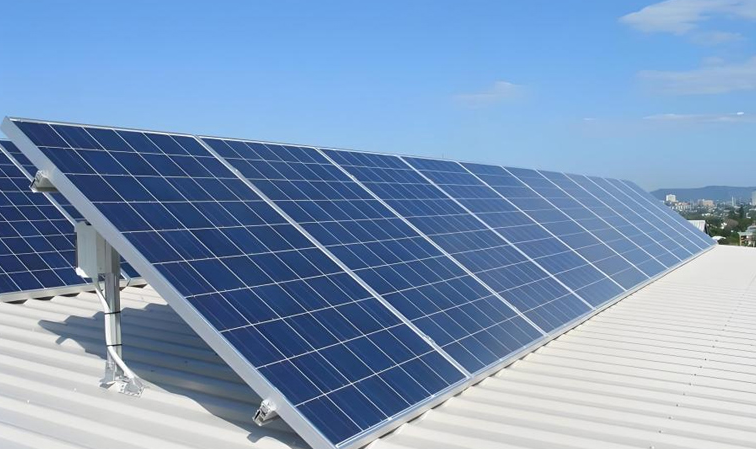
The technical mechanism by which FTO glass maintains its sheet resistance and optical performance through high-temperature annealing — and why this thermal stability translates directly into better power conversion efficiency and more consistent production yields in perovskite solar cell manufacturing — is the core technical value proposition that distinguishes FTO from ITO for high-temperature photovoltaic applications.
The thermal stability advantage of FTO glass over ITO glass in high-temperature photovoltaic processing is rooted in the fundamental material properties of the two transparent conductive oxide systems. FTO — fluorine-doped tin oxide — is based on SnO₂, a metal oxide with strong thermal and chemical stability that can withstand temperatures up to approximately 700°C without significant structural degradation. The fluorine dopants that provide the electrical conductivity of FTO are incorporated into the SnO₂ crystal lattice in a way that is relatively stable at the annealing temperatures used in perovskite processing.
ITO — indium tin oxide — provides excellent conductivity and high optical transmittance at room temperature and under low-temperature processing conditions, but is more sensitive to high-temperature degradation. At the annealing temperatures required for TiO₂-based electron transport layers in perovskite solar cells, ITO can experience changes in its electrical and optical properties that increase sheet resistance and reduce device performance. Lanjing Glass's comparison of FTO and ITO states that FTO has better high-temperature resistance than ITO and can reach up to 700°C, and notes that FTO shows relatively small resistance change after sintering — a direct statement of the thermal stability advantage that makes FTO the preferred substrate for high-temperature perovskite processing.
The connection between FTO glass thermal stability and perovskite solar cell power conversion efficiency operates through a clear device physics chain. When FTO glass maintains stable sheet resistance after high-temperature annealing, the series resistance of the finished device remains low — supporting efficient charge extraction from the perovskite absorber layer, maintaining high fill factor, and enabling the current collection efficiency that high power conversion efficiency requires. When sheet resistance increases after annealing — as can occur with thermally unstable ITO — the series resistance increase reduces fill factor, reduces current collection efficiency, and reduces power conversion efficiency in a way that cannot be recovered through optimization of other device layers.
For large-area perovskite module production, the impact of sheet resistance stability is amplified. In a large-area module, current must be collected across a larger substrate area, and the resistance of the transparent conductive layer contributes more significantly to the total series resistance of the device. A substrate that maintains stable sheet resistance after annealing enables more consistent current collection across the full module area — supporting the large-area efficiency that commercial perovskite module production requires.
Better FTO glass efficiency in perovskite solar cell applications comes from the combination of high visible light transmittance, stable sheet resistance after annealing, good coating uniformity across the substrate area, strong thermal and chemical stability through all processing steps, and compatibility with TiO₂, SnO₂, and other charge transport layer deposition processes. No single parameter determines FTO glass efficiency in isolation — it is the balance of all these parameters, maintained consistently across production batches, that enables the repeatable high-efficiency device performance that perovskite commercialization requires.
The selection of the right transparent conductive substrate for a perovskite solar cell manufacturing program involves evaluating the thermal stability, conductivity, optical performance, cost, and processing compatibility of FTO and ITO across the specific requirements of the intended device architecture and manufacturing process.
| Selection Factor | FTO Glass | ITO Glass |
|---|---|---|
| Coating material | Fluorine-doped tin oxide | Indium tin oxide |
| High-temperature stability | Strong advantage — suitable for 450°C+ annealing | More sensitive to high-temperature degradation |
| Sheet resistance stability after annealing | Relatively small change after sintering | Higher risk of resistance increase at elevated temperatures |
| Conductivity | Strong for photovoltaic applications | Often higher initial conductivity than standard FTO |
| Optical transmittance | Good — grade-dependent, typically above 82% | Often higher transmittance than FTO |
| Cost | Generally lower than ITO — no indium content | Indium content increases cost and supply chain risk |
| Etching process | Easier etching | More difficult etching |
| Best photovoltaic application | Perovskite solar cells, DSSC, thin-film solar cells, high-temperature processes | Low-temperature optoelectronics, displays, touch panels, some PV structures |
| Commercialization value | Strong for scalable high-temperature photovoltaic manufacturing | Strong where maximum transmittance and low resistance dominate at low temperature |
Lanjing Glass states that ITO has better conductivity while FTO has lower cost, easier etching, and better high-temperature resistance — and notes that FTO can be used as a substitute for ITO in fields such as thin-film solar cell substrates. This comparison captures the fundamental trade-off: ITO provides better initial electrical and optical performance under low-temperature conditions, while FTO provides better performance stability under the high-temperature processing conditions that TiO₂-based perovskite architectures require.
Choose FTO glass when the manufacturing process includes annealing at 450°C or above, when TiO₂ sintering is required for the electron transport layer, when sheet resistance stability after thermal processing is more important than maximum initial conductivity, when the project targets perovskite solar cells, dye-sensitized solar cells, or thin-film photovoltaics, when large-area production consistency is required, and when cost and supply chain stability are important procurement considerations.
Choose ITO when the manufacturing process is low-temperature, when maximum optical transmittance is the primary performance requirement, when the application is display-oriented or touch-panel-oriented, and when the process cannot tolerate the slightly higher haze or resistance trade-offs that FTO may present compared with ITO under low-temperature conditions.
FTO conductive glass delivers the most value for: perovskite solar cell manufacturers scaling from laboratory to pilot and mass production, dye-sensitized solar cell manufacturers where high-temperature processing is part of the standard fabrication process, thin-film solar cell manufacturers where substrate thermal stability is required for deposition and annealing processes, photocatalysis researchers and manufacturers where chemical and thermal stability are both required, electrochromic device manufacturers where long-term stability under electrical and thermal cycling is important, and photovoltaic research institutions developing next-generation solar cell architectures that require high-temperature processing.
Selecting the right FTO glass grade for a perovskite solar cell manufacturing program requires systematic pre-procurement evaluation of both substrate performance specifications and processing compatibility — and careful handling and storage practices that protect the FTO coating quality through the supply chain and production process.
Before ordering FTO glass for perovskite solar cell applications, buyers should confirm the following:
Confirm the required sheet resistance grade — TEK10, TEK15, TEK35, TEK70, or TEK250 — based on the device architecture and current collection requirements of the specific perovskite cell structure
Confirm the sheet resistance after high-temperature annealing at the specific temperature and duration used in the manufacturing process — do not rely only on initial sheet resistance before thermal processing
Confirm the annealing temperature and duration that the substrate will experience and verify that the selected FTO grade maintains adequate sheet resistance stability through this thermal cycle
Confirm the visible light transmittance requirement and verify that the selected grade meets the optical performance target for the device architecture
Confirm the haze value and verify that it is within the tolerance required for the optical design of the device
Confirm the substrate thickness required for the specific device structure and processing equipment
Confirm that the FTO side is clearly marked on the substrate — FTO glass is asymmetric and incorrect orientation during processing will result in device failure
Confirm the substrate size requirements — standard stock sizes or customized dimensions — and verify that the supplier can provide the required size with adequate coating uniformity across the full substrate area
Confirm whether tempering is required and verify the sheet resistance data after tempering for the selected grade
Confirm the surface compatibility with the specific deposition method being used — spin coating, slot-die coating, spray pyrolysis, or other deposition techniques — and request surface roughness data if relevant
Confirm the packaging specification for transport — FTO coating is susceptible to scratching and contamination during transport, and adequate protective packaging is essential for maintaining substrate quality
Request batch-level quality data — sheet resistance, transmittance, and haze measurements — for production batches to verify consistency before committing to large-volume orders
Always identify the conductive FTO side before processing — use a multimeter to confirm which side is conductive before beginning any deposition or processing step
Wear clean gloves when handling FTO glass — fingerprints and skin oils contaminate the FTO surface and can affect the adhesion and uniformity of subsequently deposited layers
Clean the FTO surface with approved solvent and ultrasonic cleaning procedures before coating — standard cleaning protocols for perovskite substrate preparation typically include sequential cleaning with detergent, deionized water, acetone, and isopropanol, followed by UV-ozone or plasma treatment
Avoid scratching the FTO coating during handling, cleaning, and processing — scratches in the FTO layer create local resistance increases and current collection non-uniformities that reduce device performance
Store glass panels in dry, clean packaging with protective interlayers between sheets — direct contact between FTO-coated surfaces can cause coating damage during storage and transport
Confirm the thermal ramp rate before annealing — rapid temperature changes can cause thermal stress in the glass substrate and FTO coating; follow the supplier's recommended thermal ramp rate for the specific grade
Measure sheet resistance before and after each heat treatment step to verify that the FTO coating is maintaining its performance through the thermal processing sequence
Keep batch records for process traceability — record the FTO glass grade, batch number, initial sheet resistance, post-annealing sheet resistance, and any processing anomalies for each production batch
Validate surface compatibility and coating uniformity before scaling from small-area laboratory cells to large-area modules — substrate performance that is adequate for small cells may reveal uniformity limitations at larger scales
For perovskite solar cell commercialization in 2026, substrate selection must support both device efficiency and manufacturing stability across the full thermal processing sequence — from TiO₂ annealing through perovskite deposition and module assembly. While ITO glass offers strong initial conductivity and high optical transmittance under low-temperature conditions, FTO glass provides the decisive advantage that high-temperature perovskite manufacturing requires: thermal stability that maintains sheet resistance, optical performance, and surface integrity through annealing at 450°C and above, enabling consistent current collection, stable power conversion efficiency, and repeatable production yields across large-area module manufacturing.
Lanjing Glass offers FTO conductive glass in multiple resistance grades and thickness options, with published performance data covering transmittance, haze, reflectance, and sheet resistance before and after tempering — providing the technical documentation that perovskite manufacturers need to select the right substrate grade for their specific device architecture and manufacturing process.
Contact Lanjing Glass today to discuss your perovskite solar cell structure, annealing temperature and duration, target sheet resistance, panel size requirements, coating deposition method, and pilot-production volume. The Lanjing Glass team can help recommend the right FTO glass grade for your high-temperature photovoltaic manufacturing program — and provide the technical data and sample substrates that process validation requires.
Q1: What is FTO glass and how does it differ from ITO glass?
FTO glass is fluorine-doped tin oxide coated conductive glass — a transparent conductive substrate where the SnO₂-based FTO coating provides electrical conductivity through fluorine doping. ITO glass uses indium tin oxide as the conductive coating. The key difference for photovoltaic applications is thermal stability: FTO maintains its sheet resistance and optical performance through high-temperature annealing at 450°C and above, while ITO is more sensitive to high-temperature degradation — making FTO the preferred substrate for high-temperature perovskite solar cell processing.
Q2: Why is FTO glass preferred over ITO for perovskite solar cell manufacturing?
FTO glass has stronger high-temperature stability than ITO, with relatively small sheet resistance change after sintering at the temperatures required for TiO₂-based electron transport layer processing. This thermal stability is critical for perovskite solar cell architectures that require annealing at 450°C or above — maintaining the low sheet resistance that efficient current collection and high power conversion efficiency require after thermal processing.
Q3: How does sheet resistance affect perovskite solar cell power conversion efficiency?
Sheet resistance contributes to the series resistance of the solar cell device. Higher series resistance reduces fill factor, reduces current collection efficiency, and reduces power conversion efficiency. In large-area module production, the impact of sheet resistance on device performance is amplified — making sheet resistance stability after high-temperature annealing a critical substrate selection criterion for perovskite commercialization.
Q4: What FTO glass grades are available and how should buyers choose between them?
Common grades include TEK10, TEK15, TEK35, TEK70, and TEK250, with lower numbers indicating lower sheet resistance. Grade selection depends on the device architecture, current collection requirements, and the trade-off between sheet resistance and optical transmittance for the specific perovskite cell structure. Buyers should confirm sheet resistance after annealing at their specific processing temperature — not just initial sheet resistance — before selecting a grade for production use.
Q5: What should buyers check before ordering FTO conductive glass for perovskite applications?
Buyers should confirm sheet resistance grade, sheet resistance stability after annealing at the process temperature, visible light transmittance, haze value, substrate thickness, substrate size, FTO side marking, surface compatibility with the deposition method, packaging specification, and batch-level quality data availability — and request sample substrates for process validation before committing to production-volume orders.