English
 日本語
日本語 한국어
한국어 français
 Deutsch
 Español
 italiano
 русский
 português
 Türkçe
 العربية



Fluorine-doped Tin Oxide (FTO) glass is a critical substrate for applications in photovoltaics, optoelectronic devices, and research labs. Its unique combination of high optical transparency and low electrical resistance makes it indispensable for fabricating devices like perovskite solar cells, OLEDs, and sensors. However, the full potential of FTO glass lies in its cleanliness. Even minor contaminants can deteriorate thin-film adhesion and drastically impact device efficiency, especially in high-performance applications.
In this professional guide, we’ll walk you through a robust, proven cleaning protocol to achieve a pristine, hydrophilic surface while preserving the conductive coating. Whether you're a solar cell engineer, material scientist, or academic researcher, this guide will equip you with the knowledge to optimize your FTO glass for maximum performance.
FTO glass is commonly used as a transparent electrode layer in devices where uniform conductivity and transparency are critical. However, during handling and storage, fluorine doped tin oxide coated glass surfaces can accumulate contaminants, such as:
Organic residues (fingerprints, oils, adhesives, etc.)
Dust particles and dirt
Invisible chemical residues
These contaminants can severely impact thin-film uniformity, reduce the substrate's surface energy, and inhibit proper layer adhesion, which ultimately compromises performance metrics like power conversion efficiency (PCE) in solar cells.
The goal of cleaning is to achieve an ultra-clean, hydrophilic surface without damaging the delicate conductive coating. A hydrophilic surface ensures uniform layer deposition, maximizes thin-film adherence, and improves device reliability.
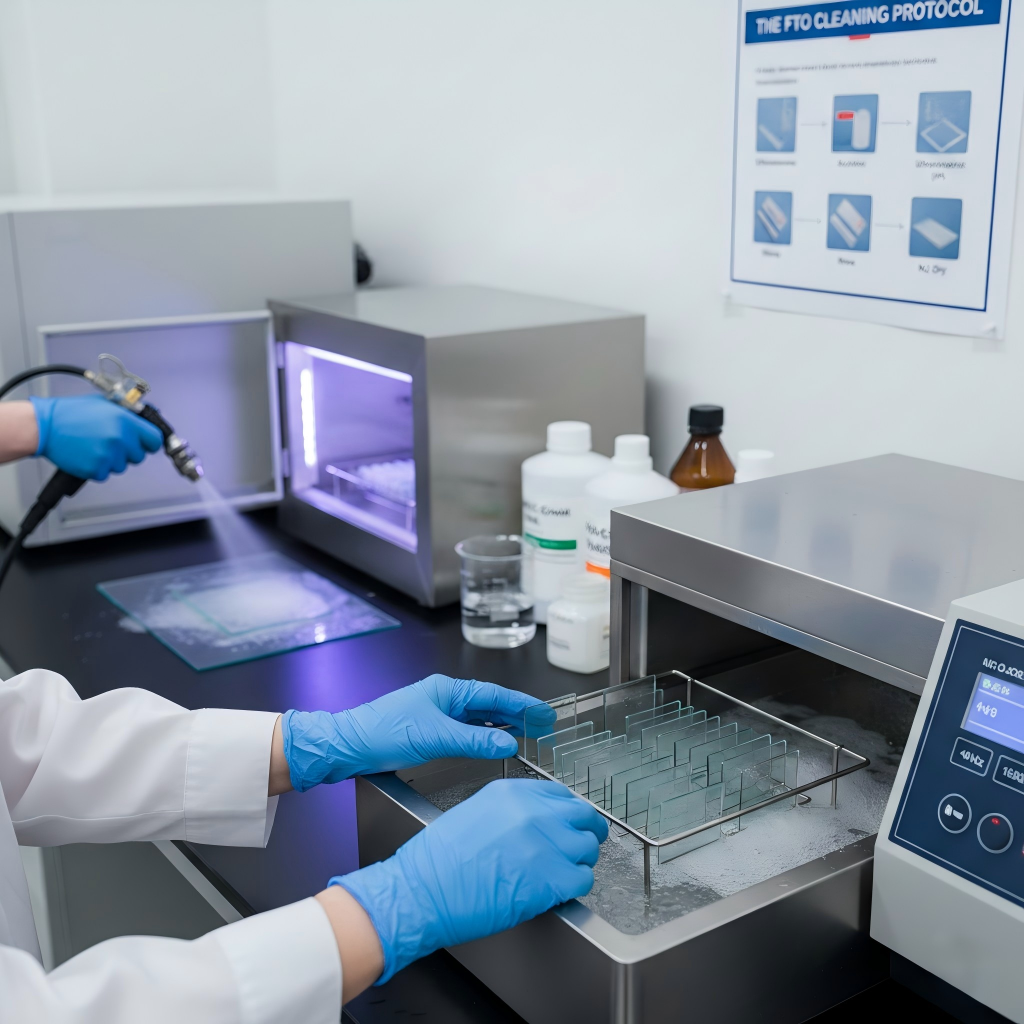
Before beginning, ensure you have the materials and tools required for laboratory-grade cleaning:
Cleaning Agents:
Deionized (DI) water (18.2 MΩ·cm)
High-purity ethanol (HPLC grade)
Isopropanol (IPA)
Acetone
Laboratory-grade detergents (Hellmanex® III, Alconox®)
Equipment:
Ultrasonic cleaner (40 kHz recommended for effective cleaning without causing damage)
Glass substrate racks (to protect from scratching)
Nitrogen (N₂) gun or air-drying system
Lint-free microfiber wipes
Pro Tip: Always handle FTO glass with clean gloves (preferably nitrile) to avoid transferring skin oils onto the conductive surface. Never touch the surface directly.
Inspect the FTO glass for visible contaminants, scratches, or damage. Only process intact substrates.
Conduct a manual rinse using DI water to remove loose dust and particulate matter.
Prepare a detergent solution with Hellmanex® III or a similar agent diluted to the manufacturer’s recommended concentration in DI water.
Place the FTO glass in a glass substrate rack, ensuring that the conductive side faces a single direction to avoid scratches or cross-contamination.
Submerge the rack in an ultrasonic bath filled with the detergent solution and operate the cleaner (40kHz frequency) for 15–20 minutes. This step removes oils, fingerprint residues, and certain organic contaminants.
Following ultrasonication, immerse the FTO glass in acetone for 5 minutes to dissolve residual organic compounds, such as oils and grease.
Transfer the glass to a second container of IPA for another 5 minutes, which removes acetone residues and ensures no solvent traces remain.
Rinse the FTO substrates thoroughly with extensive volumes of DI water (18.2 MΩ·cm) to eliminate any chemical residues.
Ensure the rinse water easily forms a full-surface sheet over the glass—this indicates a clean, hydrophilic surface.
Avoid air-drying, as this may leave mineral water spots or streaks. Instead, blow-dry the FTO glass with a nitrogen (N₂) gun, starting from one edge and sweeping consistently to the other.
To further enhance the cleanliness and functionality of the FTO glass surface, consider these advanced techniques:
Expose the FTO glass to ultraviolet (UV) light in the presence of ozone for 10–15 minutes. This step removes microscopic organic contaminants that standard degreasing might miss, ensuring high surface energy for improved thin-film deposition.
In cases where maximum wettability is required (e.g., when spin-coating active materials), use oxygen plasma treatment. This technique also activates the surface and optimizes its hydrophilicity.
Measure the water contact angle to confirm the hydrophilicity of the FTO surface. Ideally, the contact angle should measure less than 5° for a fully hydrophilic and clean surface.
Inspect the cleaned substrates under high-intensity light at an angle. Streaks or smudges indicate the presence of contaminants and necessitate re-cleaning.
Using Abrasive Materials: Avoid sponges or rough cloths to prevent scratching the FTO coating.
Using Tap Water: Minerals in tap water can deposit on the surface, creating additional cleaning challenges.
Direct Contact with the Conductive Side: Always handle FTO with gloves and avoid touching the conductive surface to prevent skin oil contamination.
After cleaning, store FTO glass in a clean, dust-free environment to prevent re-contamination. Place them in protective cases with clean covers and avoid stacking the substrates unless separated by lint-free spacers.
Achieving an optimally clean FTO glass substrate is crucial for the success of thin-film devices. Every step of the cleaning process, from detergent ultrasonication to advanced surface activation, ensures that your substrate is free from contaminants and ready for high-performance applications.
For researchers and engineers requiring consistent, low-resistance FTO glass, quality is the first priority. Check out Lanjing Glass's range of FTO glass substrates designed to meet the demanding requirements of laboratory and industrial applications.
"Even a robust cleaning protocol cannot compensate for poor-quality thin films. Choose high-quality FTO glass to ensure your devices achieve peak performance."
Q: Why is it important to use UV-Ozone or Plasma treatments for FTO cleaning after degreasing?
A: These methods remove trace organic contaminants and enhance surface energy, ensuring excellent layer adhesion for high-performance thin-film devices.
Q: Can I air-dry FTO glass after cleaning?
A: Air-drying is not recommended because it can leave water spots and cause uneven cleanliness. Use a nitrogen gas blower for best results.
Q: Can I reuse the cleaning solution?
A: No. Always use fresh cleaning solutions for accurate and reliable results, as reused solutions may redeposit contaminants onto the glass.